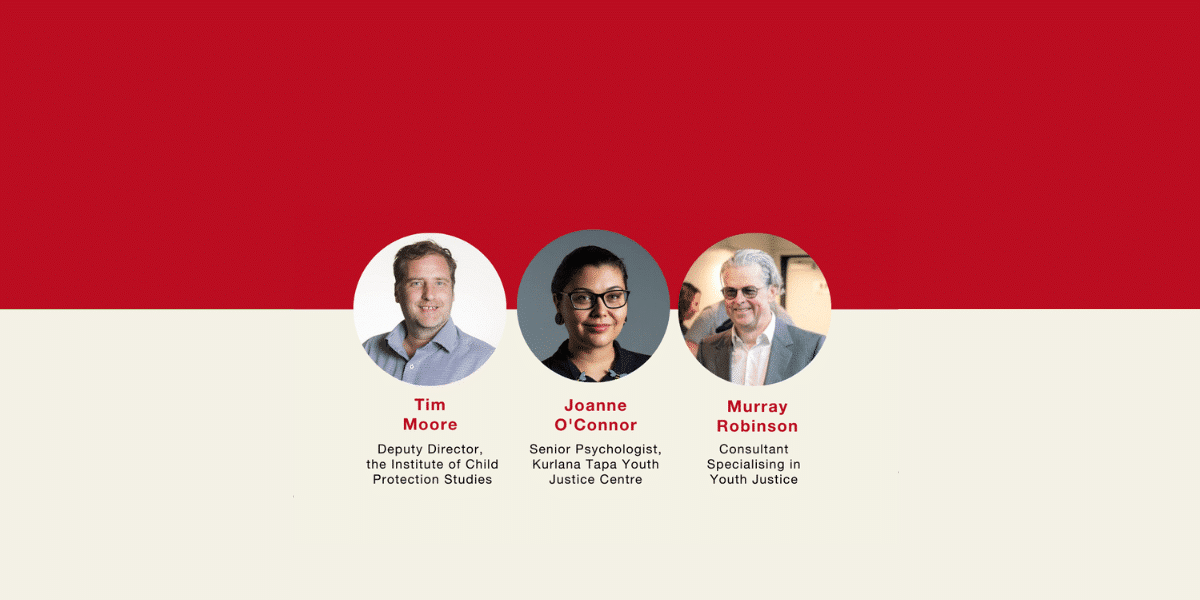
Last week, CETC facilitated an insightful panel about trauma-informed care and young people in youth detention. CETC welcomed Joanne O’Connor, Associate Professor Tim Moore and Murray Robinson to share their insights, reflections, experience and ideas with over 100 sector attendees.
Youth justice systems across Australia are grappling with balancing their role in supporting young people, with meeting community expectations about managing and responding to their behaviour. The trauma-related care needs of young people in youth detention are well established through research, and systems are developing and growing in the ways they recognise the impact of trauma and how it can impact individuals differently, but this growth and development takes time.
Our panel members shared the following reflections:
Having a whole-of-team approach at all systems and levels of management in youth justice is essential to implementing trauma-informed care.
There are promising models that need to be resourced – models that recognise and respond to trauma make the environment and community safer for everyone.
Australia is moving away from punitive approaches towards improved relational security, with consistent and predictable responses to behaviour underpinned by connection and relationship.
Any model must build the capacity of staff to provide a safe and nurturing environment and draw on the strengths of a multi-disciplinary team with different skill sets.
Being trauma informed means preparing young people for life beyond the youth justice centre, in regard to transition planning, relationship repair and connection, independent living skills, education, cultural connections and participation in decision making.
Change requires patience, tenacity and perseverance. It takes time, but it is possible. It must involve all systems that touch on, impact and influence the lives of children and young people, not just a focus on the youth justice system.
During the panel, our audience reflected on suitable models, the challenges of therapeutic care, the current “tough on crime” rhetoric, recidivism, and the broader system requirements to ensure holistic and wrap-around responses for children and young people.
Our key takeaway? Young people are seeking relationships and safe adults who care. They need to be seen, heard, championed, advocated for, and accepted when they muck up. They want to be seen beyond their behaviour and nurtured to grow – which is the right of every child.
Thank you again to our inspiring and committed panel members for sharing their time with us and the sector.
The trauma literature can be overwhelming. Its basis in neuroscience offers incredible insights into its impact. But it also is challenging to decipher and make relevant to the ways in...
Depending on who or what you read, trauma will be defined in a variety of ways. Is it simple or complex? Developmental, relational or attachment oriented? Within the field of...
There is a nexus between living in Out of Home Care (OOHC) and being involved with the criminal justice system. In NSW children and young people in OOHC have been...