
Reconciliation is not a spectator sport
May 2026
Written by Madison Connors
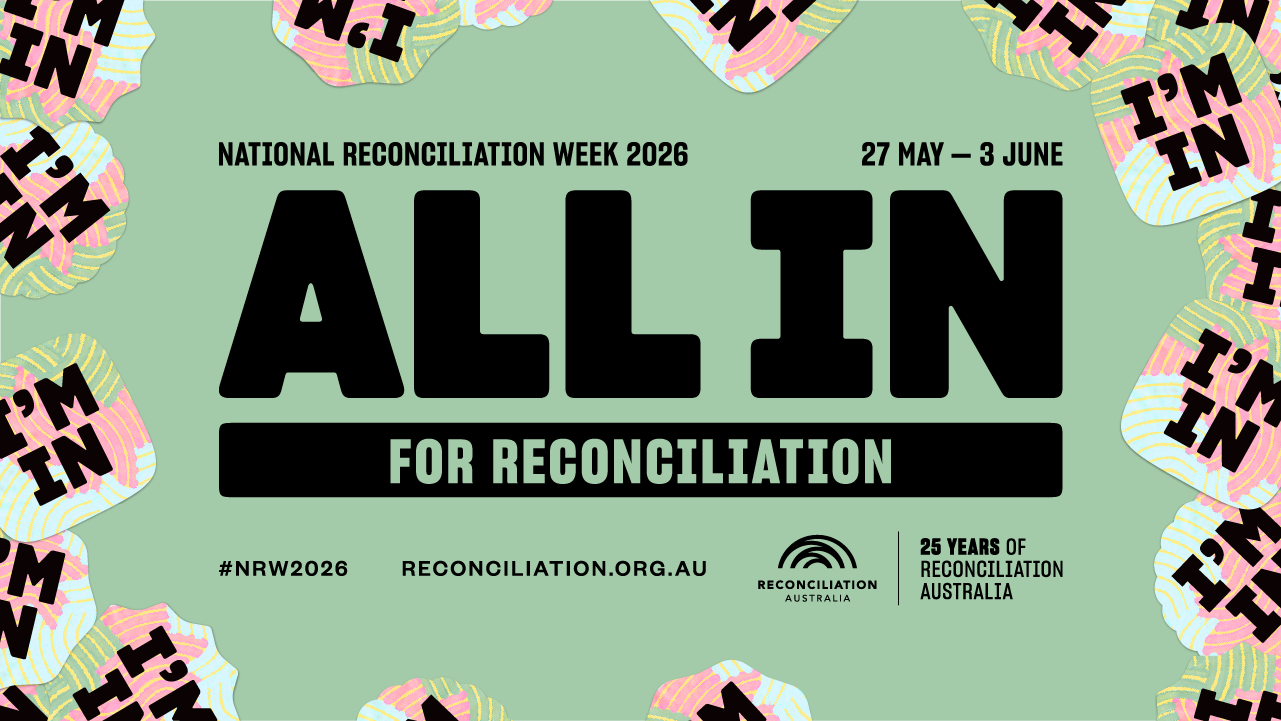
This National Reconciliation Week, the theme is All In – a direct challenge to every Australian, and every organisation, to step off the sidelines and commit. Here’s what that really means for Australian Childhood Foundation.
There is a phrase that gets used a lot around this time of year: “we acknowledge and respect.” It appears at the tops of emails, at the start of meetings, on website footers. It is not wrong to say it. However, Reconciliation Australia’s theme for 2026 is a question directed squarely at what happens after those words – after the acknowledgement, after the week, after the morning tea with the damper and the Aboriginal art tablecloth brought from Kmart. The question is simply: then what? All In. It is two words, and they carry significant weight. Reconciliation, the theme tells us, is not a spectator sport. It is not something that happens to Australia – it is something Australia must choose, repeatedly, in every institution, every team, every conversation. And crucially, it is not the responsibility of Aboriginal and Torres Strait Islander people to carry alone. We as First Nations peoples have carried it for long enough.
“Reconciliation will not happen by itself. Meaningful change requires all of us to be all in – not just during this week, but every single day.”
– RECONCILIATION AUSTRALIA, NRW 2026
Two dates that changed Australia
National Reconciliation Week runs from 27 May to 3 June every year, and the dates are not arbitrary. They bracket two of the most significant legal and democratic moments in Australia’s history. On 27 May 1967, Australians voted in what remains the most successful referendum in the nation’s history. 90.77 per cent of Australian voters said yes to – changing the Constitution to allow the Federal Government to make laws for Aboriginal and Torres Strait Islander peoples, and to count them in the national Census. Until that day, they were not counted as citizens in their own country.
On 3 June 1992, the High Court delivered the Mabo decision – the culmination of Eddie Koiki Mabo’s decade-long legal fight to have his people’s connection to Mer (Murray Island) legally recognised. The decision overturned the doctrine of terra nullius: the legal fiction that Australia had been empty, ownerless land before colonisation. Mabo died five months before the judgement was handed down. He never heard it. These two dates matter because they remind us that change is possible – that the arc of history can bend – but that it bends slowly, and only when people push. The 90.77 per cent who voted yes in 1967 were ordinary Australians making an extraordinary choice. That is the inheritance All In asks us to claim.
What this has to do with children
At Australian Childhood Foundation, reconciliation is not a parallel track to our work. It runs through the centre of it. The children we support include Aboriginal and Torres Strait Islander children who are, statistically, among the most over-represented in child protection systems in the world. Not because of anything inherent to their communities – but because of the accumulated, ongoing structural impacts of colonisation: the Stolen Generations, the forced dispersal from Country, the deliberate destruction of kinship systems, the institutionalised racism embedded in the very services meant to protect them.
The Bringing Them Home report was handed down in 1997. It documented in devastating detail the harms of forced child removal across generations, and made 54 recommendations for healing and accountability. Most remain unimplemented. That is not history. That is now.
For Aboriginal and Torres Strait Islander children who have experienced trauma, reconnection to Country, kin, and culture is not supplementary to healing – it is healing. Cultural identity is a protective factor. Strong culture produces stronger, more resilient children. This is not sentiment. It is evidence.
So, when Australian Childhood Foundation staff say “All In” this week, we are not just speaking in generalities about reconciliation as a national aspiration. We are speaking about the specific children in our specific care – and about whether our practice genuinely honours the cultural rights, the identity, and the dignity of every Aboriginal and Torres Strait Islander child who comes through our doors.
The weight that shouldn’t be carried alone
One of the most important things All In says – quietly but clearly – is this: reconciliation is not First Nations people’s responsibility to carry. For decades, the labour of reconciliation has fallen disproportionately on Aboriginal and Torres Strait Islander people themselves. They have been the ones to explain, educate, advocate, absorb the emotional weight of casual racism, correct the record, attend the working groups, lead the committees, carry the cultural load in workplaces never designed with them in mind.
All In is an invitation – and a demand – for non-Indigenous Australians to shoulder their share. To do the reading before asking. To advocate in rooms where First Nations voices are absent. To sit with discomfort rather than looking away. To make reconciliation something we practice, not something we perform.
What allyship actually looks like at Australian Childhood Foundation
It looks like using Acknowledgements of Country with genuine understanding of whose Country you are on – not as a rote opener, but as a grounding practice. It looks like not expecting Aboriginal and Torres Strait Islander colleagues to be the only voice in any conversation. It looks like remembering we have two ears and one mouth for a reason, to listen twice as much as we speak – to allow spaces for First Nations voices. It looks like reading the documents – the RAP commitments, the Closing the Gap targets, the Bringing Them Home recommendations – and asking: where does my role connect to these? It looks like noticing when cultural labour is being distributed unequally in your team and saying something. It looks like building knowledge across the whole year – one book, one podcast, one conversation at a time – so that your understanding deepens rather than refreshing and resetting each May. It looks like understanding that allyship is a verb. It is earned through consistent, repeated action. It cannot be declared. It can only be demonstrated.
The oldest living cultures on earth
Here is a fact worth sitting with: Aboriginal and Torres Strait Islander peoples hold the world’s oldest continuous living cultures. At least 65,000 years of knowledge, story, law, language, and connection to Country. That is three times longer than the entire span of Western civilisation.
There are over 250 distinct language groups across Australia. Each with its own Country, its own Lore, its own Dreaming. Language is not just communication – it encodes thousands of years of ecological knowledge, of relationship, of responsibility to Country and to one another.
The National Reconciliation Week 2026 artwork – created by Otis Hope Carey, a Gumbaynggirr/Bundjalung artist – uses the ocean as a metaphor for this moment. Swirling waters, people from all walks of life coming together, all in the same current. “All of my paintings connect to water,” he has said. “This artwork uses the ocean as a metaphor for people from all walks of life swirling together to be ‘all in’ for reconciliation.” It is a generous image. It asks us to see ourselves as part of the same body of water – not separate, not distant, but already in relationship whether we acknowledge it or not. The only question is whether we will swim.
After the week
The real test of All In is not what happens between 27 May and 3 June. It is what happens on 4 June, and in every week that follows.
Reconciliation Week carries a risk that every annual commemoration carries; it can become a container for good intentions that stays firmly shut for the other 51 weeks of the year. A morning tea. A social media post with the right hashtag. A poster in the staffroom. And then: back to normal.
All In pushes directly against this. It asks us to locate our reconciliation commitments not in a calendar event, but in our daily practice – in supervision sessions, in case reviews, in policy discussions, in how we speak about the families we serve, in how we design services, in who we hire, in who we listen to.
For Australian Childhood Foundation staff, that means one thing above all: the Aboriginal and Torres Strait Islander children in our care deserve an organisation that is fully committed to their cultural rights, their identity, and their healing – not just during National Reconciliation Week, but every single day of the year.
We are all in. Or we are not yet.
Five days of resources for Australian Childhood Foundation allies
We’ve put together a day-by-day learning guide for National Reconciliation Week 2026 – beautiful facts, context, actions, and a curated library of books, films, documentaries, podcasts, and audiobooks. Share it with your team.
Key dates
27 May 1967 Referendum
90.77% voted yes. The most successful referendum in Australian history.
3 June 1992 Mabo Decision
Overturned terra nullius and recognised First Nations connection to Country.
26 May National Sorry Day
Commemorating the Stolen Generations, observed annually.
July 2026 NAIDOC Week
Celebrating the history, culture and achievements of Aboriginal and Torres Strait Islander peoples.
Key links
- reconciliation.org.au NRW 2026 resources, events & choir registration
- aiatsis.gov.au/explore/map AIATSIS Map of Indigenous Australia
- nitv.org.au National Indigenous Television
- Colonial Frontier Massacres, Australia, 1780 to 1930 – content warning is essential for First Nations staff – The colonial Frontier Massacrea in Australia map
- The Healing Foundation | Stolen Generations Map content warning is essential for First Nations staff as this map shows 523 institutions where Stolen Generation babies and children were removed to under government policies to forced removal.
Share this with your team. Reconciliation belongs in every meeting, every supervision, every day. #NRW2026 · #AllIn
Start here
Sand Talk Tyson Yunkaporta – book: Challenges Western frameworks for knowledge, economy, and relationships.
The Australian Dream ABC iView: Stan Grant on race, belonging, and Australian silence Rabbit-Proof Fence Essential viewing for anyone in child protection.
The Last Daughter (2021) – Netflix & ABC iView: a true story about the lifelong impact of child removal in real time.
Frontier War Stories – podcast on Spotify or apple podcast: The history that wasn’t taught in schools The Yield — Audiobook Tara June Winch narrates her own Wiradjuri language
Australian Childhood Foundation acknowledges the Traditional Custodians of the many Countries on which we work across Australia, and pays respect to their Elders past, and present. We are committed to reconciliation as a living, daily practice – not only a week-long event.