Boys are children too
Nov 2026
Written by Conor Pall
This article was first published at The Man Cave.
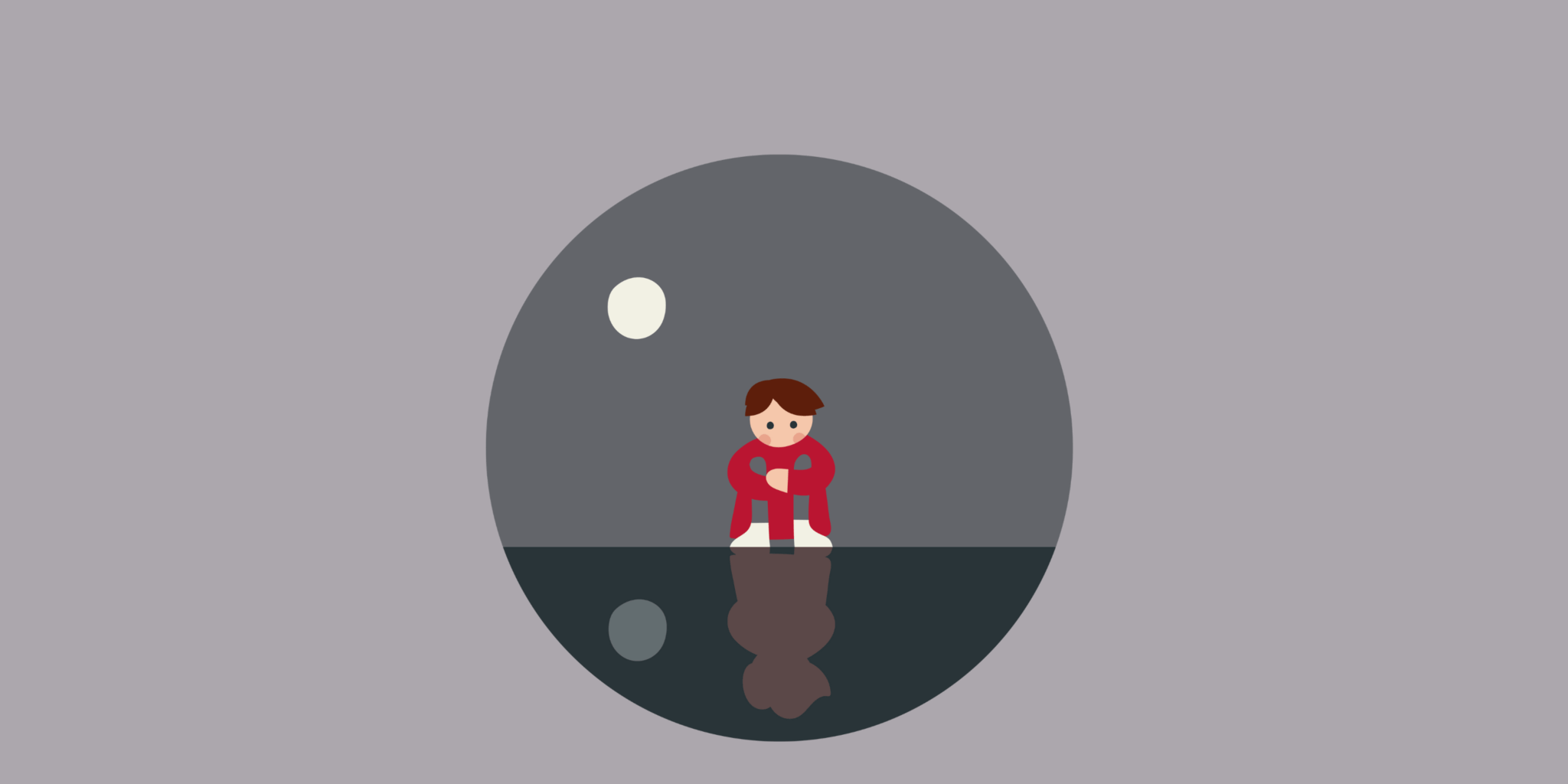
An entire childhood can pass while adults discuss what violence might mean for the person a child will become.
Children keep making something of the world we give them, even when the world is frightening. They form friendships, invent things, get things wrong, and discover what makes them laugh. Joy can live alongside vigilance. Affection can live in relationships that are unsafe. A child can love someone, fear them, and struggle to find words that make sense of both.
Recognising this complexity invites more of us than imagining a carefree childhood on one side and a child who has experienced trauma on the other. Violence does not become the whole of a child. Nor does a child’s capacity to laugh, create or carry on, make the violence less serious or any less deserving of support.
Children deserve to be understood in the fullness of their lives.
That is the concern we want to carry forward from the recent panel at the Hatchery Conference in Sydney: Engaging boys and men to end the cycle of violence. What happens to childhood inside the phrase “men and boys”?
The grouping has a purpose in work to challenge harmful gender norms. But it also needs care. A boy can exercise power in one relationship and be profoundly dependent in another. Gender shapes the expectations placed on him, the harm he may experience or cause, and whether adults recognise his distress. A gendered analysis should help us understand those relationships more precisely.
It should also leave us able to see a child.
At the recent conference, Ben hosted a panel that Conor was part of titled “Beyond our own domains: Building collaboration across the field”. The panel brought together three important voices for a conversation about engaging boys and men in preventing violence. Professor Michael Flood brought decades of academic research and evidence about masculinities, gender and violence prevention. Daniel Principe brought the perspective of a youth advocate and educator, working directly with young people to challenge harmful norms and help boys navigate the complexities of growing up. And Conor Pall, a social worker and Lead of Youth Engagement and Advocacy with the Australian Childhood Foundation, brought something very powerful: the wisdom of lived experience, alongside his professional commitment to ensuring children and young people are seen, heard and supported.
Conor’s continued courage in sharing his own experiences of family violence deserves particular recognition. There is an extraordinary generosity in repeatedly revisiting painful parts of your childhood so that other children might have a different one. His advocacy reminds us that behind every statistic, every policy framework and every conversation about preventing future harm is a child whose safety, dignity and wellbeing matter right now.
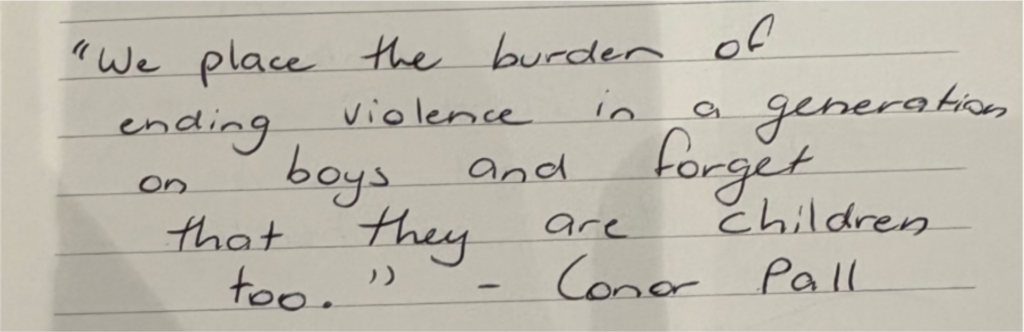
Picture supplied: A conference delegate taking notes on what Conor Pall had to say on the panel.
The conversation reinforced something fundamental: are we leaving boys out of the very systems designed to support and protect them? We have decades of research, compelling evidence and courageous advocates. Yet we still lack the coordinated, accessible and adequately resourced pathways to safety, recovery and healing that children and young people deserve.
Conor challenged us to confront a particularly uncomfortable gap: while we have become increasingly sophisticated in identifying and responding to young people who use violence, we have been far less successful in building dedicated responses for children experiencing it, including boys.
Victoria offers a telling example. Since 2023, the state has funded a statewide Adolescent Family Violence in the Home (AVITH) program, supporting young people aged 12 to 17 who use violence against family members. Yet specialist, child-centred family violence response and recovery services remain fragmented, unevenly available and significantly under-resourced. Some children in our country are waiting up to three years to access specialist therapeutic support to heal from experiences of violence. Some will age out of eligibility before they reach the top of the waitlist.
This is not an argument against accountability or investment in responding to harmful behaviour. Both are essential. It is a question of whether we have invested as deliberately in helping boys heal as we have in responding when they may cause harm.
Surely, a system committed to ending violence must be capable of doing both.
Conor was six when police came to his home in response to a family violence incident. He was sitting on the floor of his room. No one spoke to him.
At 16, after years of family violence, he called a specialist family violence service for help. He was asked by the practitioner whether he was a perpetrator.
There were ten years between those encounters. Those years were his childhood.
The child overlooked on the couch and the teenager questioned on the phone were the same person, still trying to find safety. What changed was how adults sought to understand him.
This is why it matters when boys become visible chiefly through concern about the men they might become. We can become so occupied with identifying future harm that we fail to respond to harm already happening.
Being recognised as a child must never depend on performing an adult’s idea of innocence. Children can be angry, challenging to understand, protective, withdrawn or capable of hurting someone else. Where they cause harm, the impact matters and others need protection. Their own rights and needs remain. An effective response must be capable of holding those responsibilities together.
This belongs in our national response to violence against women and children. Boys experiencing family violence are already within its remit. Their safety is one of the outcomes that response exists to create.
Men’s wellbeing and preventing men’s violence are distinct aims. But a boy seeking help because of his experiences of family violence should not disappear between an argument about men’s wellbeing and an argument about preventing men’s violence. He is a child experiencing men’s violence today.
Consider what happens when a respectful relationships lesson gives a child the language to recognise something happening at home. That can be a moment of enormous possibility, and amounting fear.
What happens when they tell someone?
If there is nowhere appropriate for them to go, we have helped them name the violence without providing a way to seek safety. Prevention and response meet in that child’s life. Our systems need to meet them there too.
The Second Action Plan should make this possible by investing in: specialist support that children and young people can access in their own right; adults equipped to recognise and respond to their experiences; sustained therapeutic support; and meaningful opportunities for young people to shape the services designed for them. Its commitments must reach girls, boys and gender-diverse children, recognising the different circumstances, experiences and needs that shape their lives.
Ultimately, we hope the Second Action Plan helps us move beyond the false choice between caring for boys and holding boys accountable. We can be unequivocally committed to gender equity, to ending men’s violence against women and children, and to recognising that boys themselves can be victims of that same violence. If we are serious about breaking cycles of violence, we must be willing to see boys in all their complexity: not simply as future men to be shaped, potential perpetrators to be prevented, or problems to be solved, but as children deserving of safety, dignity, compassion and the opportunity to thrive.
There is no single childhood to protect. There are children with different ways of communicating, different relationships, different experiences of power, and different things they need from us. Seeing boys as children too is part of making our response capable of reaching all of them.
We cannot give Conor those ten years again. We can decide whether the next child on the couch is spoken to. Whether the next teenager on the phone finds a service that knows how to help.
We do not have to know who a child might become to recognise what we owe them now.
____________________________________________________________________________
Conor Pall is a social worker, lived-experience advocate and Lead of Youth Engagement and Advocacy at the Australian Childhood Foundation.
Ben Vasiliou is the CEO of The Man Cave and author of Better Man.